
Bitbucket is Atlassian's Git-based code hosting and CI/CD platform, combining version control, pipelines, code review, and AI features with native Jira integration.
About
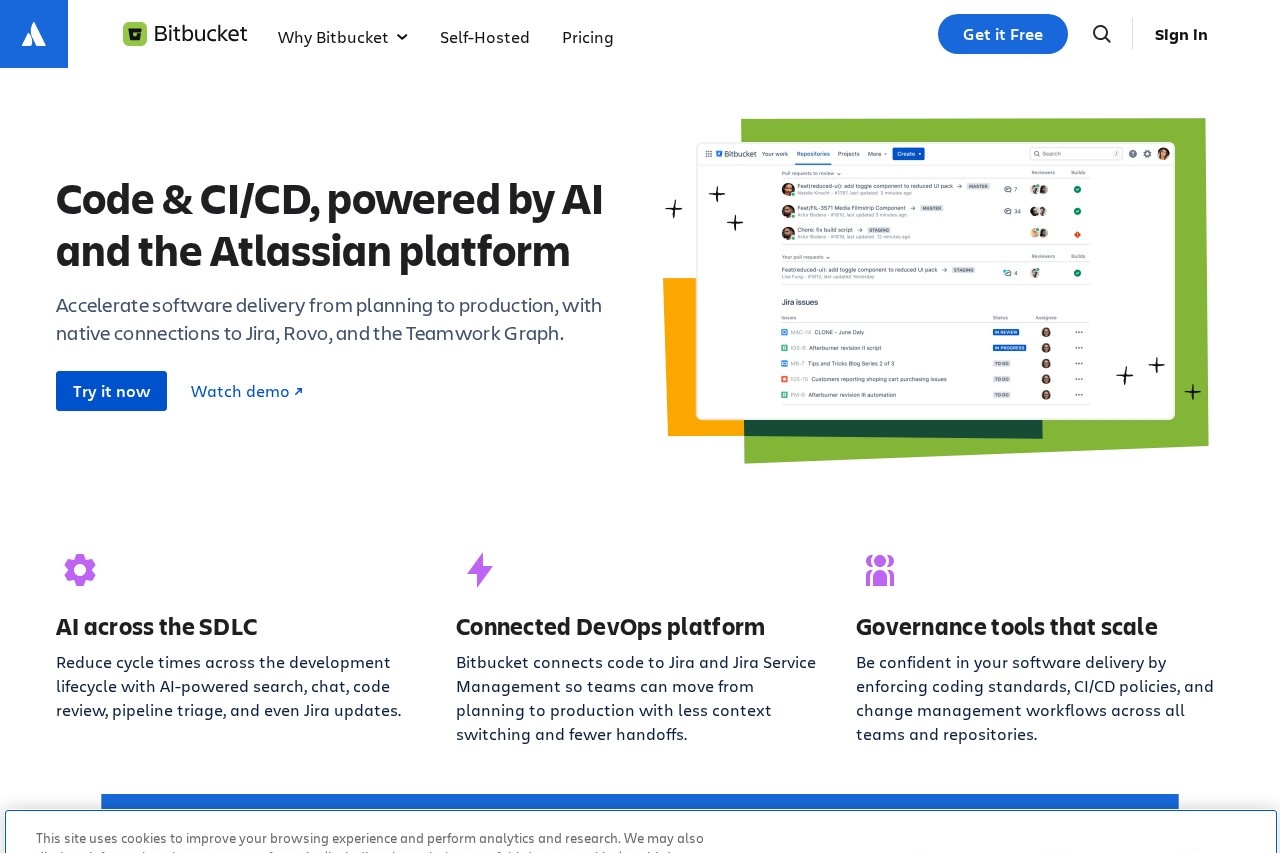
Bitbucket is a Git-based code hosting and continuous integration/continuous delivery (CI/CD) platform from Atlassian, designed for teams that plan and track work in Jira. It addresses a common friction point in software delivery: code, planning, and deployment often live in separate tools, forcing developers to switch contexts and lose traceability between what changed and why it changed.
At a high level, Bitbucket Cloud combines Git repositories, pull-request-based code review, and Bitbucket Pipelines for CI/CD in a single workspace. Its differentiating strength is native integration with the Atlassian platform: commits and branches can be linked to Jira issues, and deployments connect to Jira Service Management, so teams can follow work from planning through to production. Atlassian reports that 15 million developers build on Bitbucket. Recent releases add AI capabilities — including AI code review, code generation through Rovo in the CLI and IDE, and agentic pipeline automations — alongside governance controls such as merge checks, deployment permissions, and IP allowlisting.
Key Features
Pricing & Fees
- Pricing: Bitbucket Cloud is free for up to 5 users with unlimited public and private repositories, 50 build minutes, and 1 GB of LFS file storage. Standard costs $3.65 per user/month, and Premium costs $8 per user/month; a self-managed Data Center option is available by contacting sales.
- Premium tier: Premium adds enforced merge checks, IP allowlisting, deployment permissions, required two-step verification, and exclusive access to Atlassian Intelligence features.
- Free trials and migration support: Free trials are available for Standard and Premium, and Data Center customers can trial Premium free for the same user count and license duration; a free app migrates code and users from Bitbucket Server or Data Center to Cloud.
- Community and academic subscriptions: Verified community and academic users get unlimited private repositories with unlimited contributors, 5 GB of LFS storage, and 500 build minutes.
Who It's For
Bitbucket is built for software teams that already use — or plan to use — Jira for planning and tracking. Typical users include application developers who need Git hosting with built-in CI/CD, DevOps engineers orchestrating pipelines across an organization, and engineering leaders who need traceability from Jira issues through code review to production deployments. It suits growing startups on the free or Standard tiers as well as enterprises that need compliance controls like required merge checks, IP allowlisting, and two-step verification. Teams with strict regulatory or security requirements can choose the self-managed Data Center offering instead of the cloud product.
FAQ
What is Bitbucket?Bitbucket is Atlassian's Git-based code hosting and CI/CD platform, offering repositories, pull requests, pipelines, code review, AI features, and native integration with Jira and Jira Service Management.
Is Bitbucket free to use?Yes, the Free plan costs nothing for workspaces of up to 5 users and includes unlimited public and private repositories, 50 build minutes, and 1 GB of LFS file storage shared across the workspace.
How much does Bitbucket Cloud cost?The Standard plan is $3.65 per user per month and the Premium plan is $8 per user per month; Data Center pricing is not publicly listed on the pages reviewed and requires contacting Atlassian.
What tools does Bitbucket integrate with?Bitbucket integrates natively with Jira, Jira Service Management, and Atlassian Rovo, and connects to partner tools across AI code generation, security, testing, and monitoring, with custom integrations also supported.
How does Bitbucket handle security and compliance?It provides customizable merge checks to enforce code quality policies, shift-left security integrations, and granular permissions at workspace, project, repository, branch, environment, and package levels; Premium adds IP allowlisting, deployment permissions, and required two-step verification.
Related Tutorials
View all →
Related Tools
View all → CodeBuddy - AI-Powered IDE for Efficient Coding CodeBuddy is an AI-driven IDE that boosts coding efficiency with intelligent assistance.
 Claude Claude is an AI assistant made by Anthropic that answers questions, writes and edits text, analyzes documents, and helps with coding through natural conversation.
 RTK - Rust Token Killer RTK reduces Claude Code token usage by 60-90%, measured across 2,900+ real commands. Removes 89% avg noise, extends sessions 3x, zero config. MIT licensed.
 Claude Code Templates Browse and install 1000+ pre-built components for Claude Code. Includes AI agents, slash commands, MCP integrations, hooks, and settings. Free, open-source CLI tool.
 Code-review-graph - Local Code Intelligence for MCP Persistent local code graph for token-efficient AI code review through MCP and CLI. 8.2x avg context reduction, 30 MCP tools, local-first by default.