
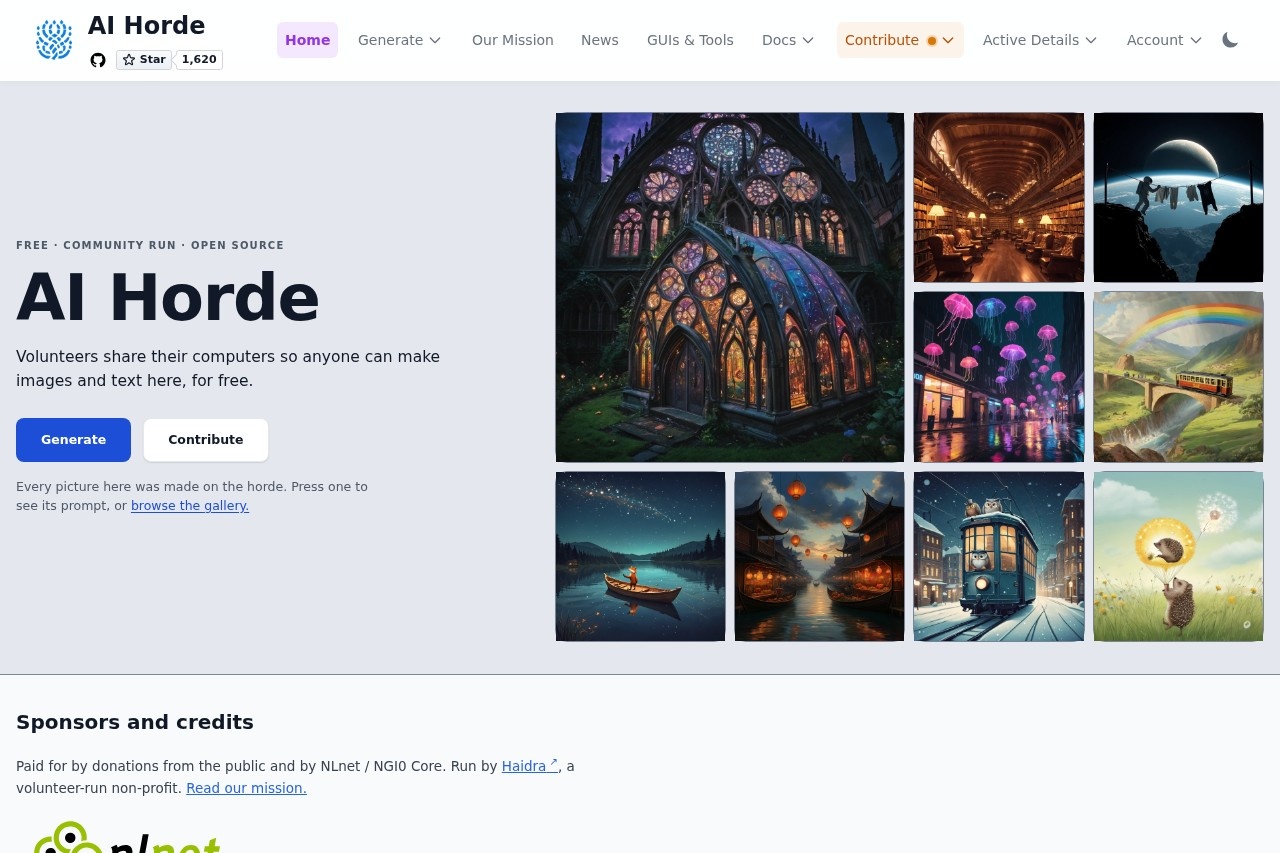
AI Horde is a free, community-run, open-source crowdsourced network where volunteers share their GPUs so anyone can generate AI images and text in a browser.
About
AI Horde is a free, community-operated service that lets anyone generate AI images and text without installing software or paying for a subscription. It solves a practical problem: running generative AI models locally requires expensive hardware, while commercial services typically charge per image. AI Horde instead crowdsources computing power from volunteers around the world.
Visitors submit prompts through a web interface or third-party GUIs, and a distributed network of volunteer-run workers processes the requests. The project is operated by Haidra, a volunteer-run non-profit, funded by public donations and NLnet / NGI0 Core. It is open source, with code available on GitHub, and users can contribute by running a worker, donating, or earning "kudos," the community's internal credit system. The platform supports multiple models, including AlbedoBase XL, Flux.1-Schnell, Stable Cascade, DreamShaper XL, Juggernaut XL, and Cheyenne, and offers a documented REST API for developers.
Key Features
Pricing & Fees
- Pricing: Free; the service is supported by public donations and NLnet / NGI0 Core rather than paid plans.
- Open source: Run by Haidra, a volunteer-run non-profit, with source code published on GitHub.
- No installation required: Generation works in a standard web browser, though third-party GUIs and tools are also supported.
- Community channels: Active Discord, Patreon, GitHub, Mastodon, and Lemmy presences for support and news.
Who It's For
AI Horde suits hobbyists and creators who want to experiment with AI image generation without buying a GPU or paying for a commercial service. Developers can integrate its REST API into their own applications and interfaces. Open-source advocates and users with spare hardware can participate as workers, earning kudos while supporting free access for everyone. It also fits prompt enthusiasts who enjoy studying and reusing the prompts behind community-generated images in the public gallery.
FAQ
What is AI Horde?AI Horde is a free, community-run, open-source service where volunteers share their computers' processing power so anyone can generate AI images and text.
Is AI Horde free to use?Yes, generation is free; the project is funded by public donations and a grant from NLnet / NGI0 Core, with no paid plans advertised on the site.
Do I need to install anything to use AI Horde?No, images and text can be generated directly in a browser, and third-party GUIs built on the Horde's REST API are also available.
Who runs AI Horde?It is operated by Haidra, a volunteer-run non-profit, with source code publicly available on GitHub under the Haidra-Org organization.
How can I contribute to AI Horde?Users can contribute by running a worker on their own hardware, donating, or building tools on the documented REST API, and contributors earn kudos.
Related Tutorials
View all →
Related Tools
View all → Leonardo.Ai Leonardo.Ai is an AI image generation platform that helps designers, marketers, and artists create production-ready visual assets with consistent style control.
 Civitai Civitai is an online community and sharing platform where creators publish, discover, and download AI image generation models, mainly for Stable Diffusion.
 PixAI PixAI is a free online AI anime art generator where users create anime-style images and videos from text prompts using 1.8M+ community models and LoRAs. Depositphotos AI Image Generator A text-to-image generator from the Depositphotos stock content platform that creates original, licensed visuals for marketers, designers, and small businesses. aigazou aigazou is a free AI image generator that creates images from text prompts without requiring an account, aimed at both personal and commercial use.