TensorZero
Open-source infrastructure for production LLM applications: gateway, observability, optimization, and evaluation tools.
Introduction
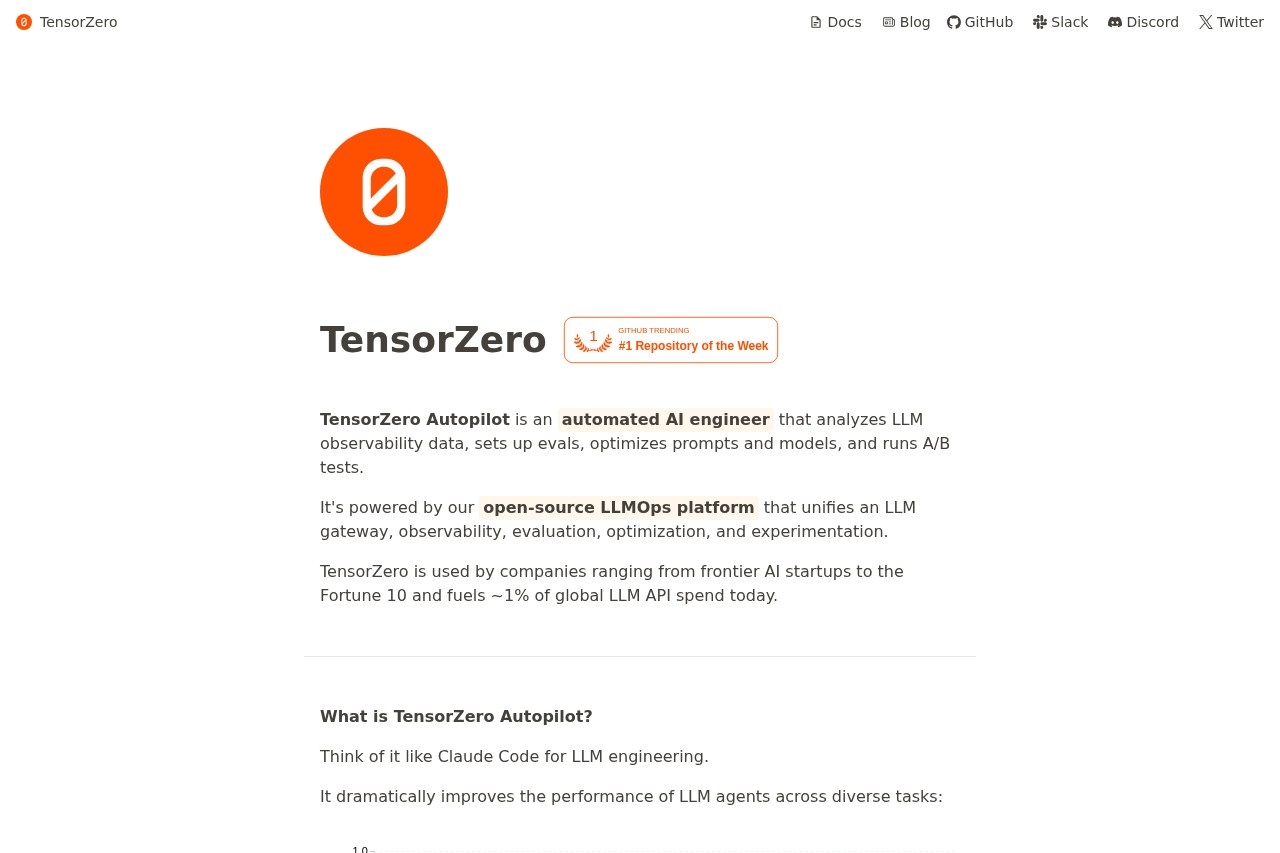
As large language model (LLM) applications continue to evolve at a rapid pace, developers face a host of complex challenges when moving from prototype validation to stable, efficient production deployment—including monitoring, management, optimization, and evaluation. TensorZero was built to address these challenges head-on. It is an open-source infrastructure suite designed specifically for production environments, providing powerful gateway, observability, optimization, and evaluation tools that help teams seamlessly bridge the gap between experimentation and production.
Key Features
- Intelligent Gateway: A unified API entry point that supports multi-model routing, load balancing, rate limiting, and authentication management.
- Deep Observability: Real-time tracking of every LLM call, with detailed performance metrics, cost analysis, and log records.
- Performance and Cost Optimization: Built-in caching, smart fallback mechanisms, prompt compression, and model selection strategies to reduce latency and cost.
- Systematic Evaluation: Frameworks and tools for automated testing, benchmark assessment, and version comparison of model outputs.
Highlights
- Open and Transparent: Fully open source and community-driven, avoiding vendor lock-in while allowing for free customization and extension.
- Production-Ready: Purpose-built for high-availability, scalable production environments with enterprise-grade features included.
- Full-Stack Integration: Feature modules work together seamlessly, delivering an end-to-end solution from traffic management to performance evaluation.
- Developer-Friendly: Clear documentation, an easy-to-deploy architecture, and rich APIs significantly boost development efficiency.
Who It's For
TensorZero is the ideal choice for AI product teams looking to deploy LLM prototypes quickly and reliably into live services, MLOps engineers who need to build observable and maintainable LLM application infrastructure, independent developers and research groups seeking powerful enterprise-grade tools without the high cost, and any team focused on cost and performance that requires fine-grained management and optimization of LLM calls.