NVIDIA Cosmos - Physical AI with World Foundation Models
NVIDIA Cosmos accelerates physical AI development with world foundation models, enabling realistic simulation and training for AI systems.
Introduction
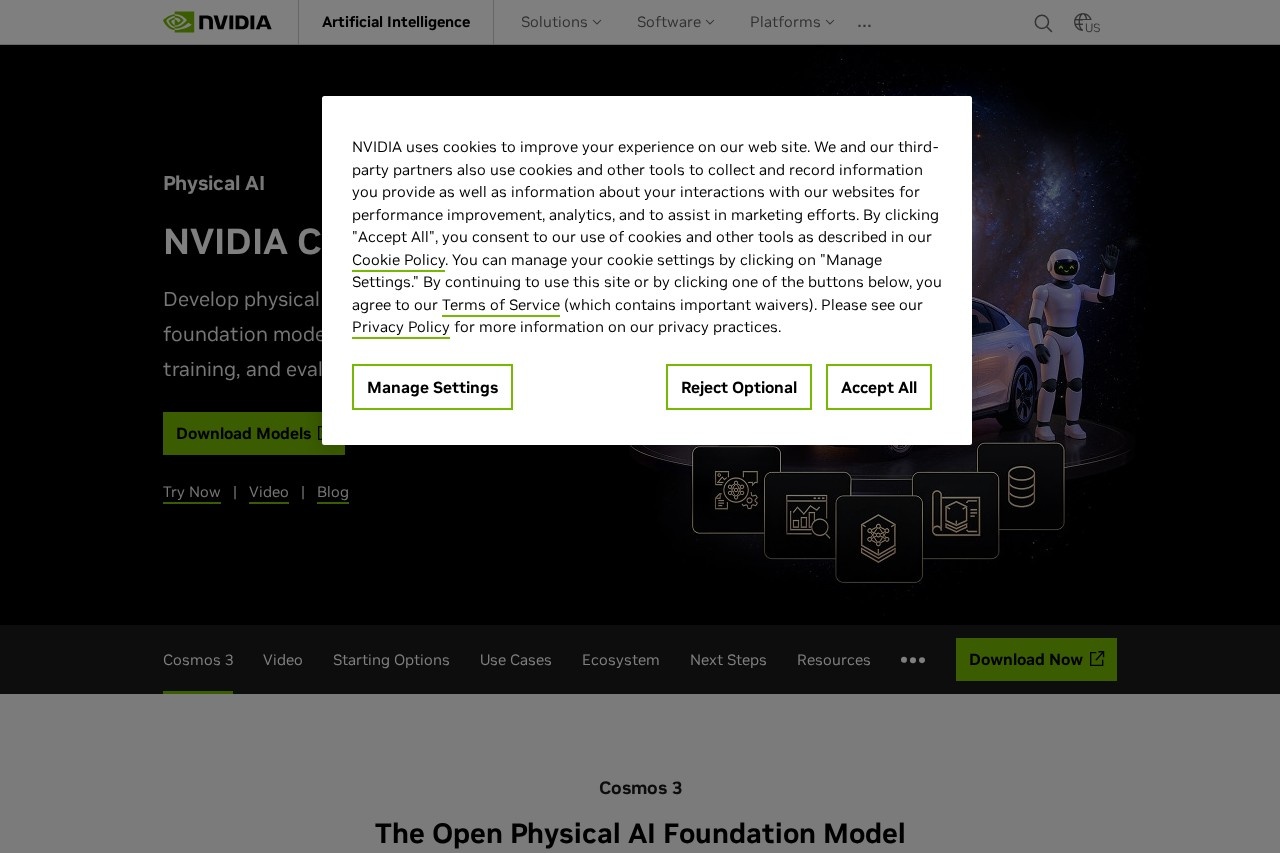
At the critical turning point where artificial intelligence moves from the digital world into the physical world, the NVIDIA Cosmos platform has emerged with the goal of leading the field of physical AI. The platform integrates advanced World Foundation Models, efficient tokenizers, safety guardrails, and accelerated data processing and curation pipelines, providing developers with a complete toolchain. Cosmos is designed to help robotics and autonomous driving systems better understand, predict, and interact with the real world, driving physical AI from concept to large-scale deployment.
Key Features
- World Foundation Models: Pre-trained models that understand the dynamic laws of the physical world, supporting scene generation and causal reasoning.
- Advanced Tokenizers: Efficiently convert complex physical sensor data (such as visual and radar signals) into semantic units that AI systems can process.
- Intelligent Guardrails: Built-in safety and ethical validation mechanisms that ensure AI decisions comply with physical constraints and safety standards.
- Accelerated Data Processing Pipelines: Automated data cleaning, annotation, and curation that dramatically shorten the cycle from raw data to usable training sets.
Highlights
- End-to-end integration: Developers can directly access validated world models and data processing tools without building infrastructure from scratch.
- Deep optimization for NVIDIA hardware: Fully leverages GPU acceleration for real-time inference and training.
- Open and extensible: Supports custom model fine-tuning and is compatible with major robotics operating systems and simulation environments.
- Lowers the barrier to entry for physical AI research and development.
Who It's For
Robotics development teams looking to build intelligent machines with environmental awareness and autonomous navigation capabilities. Autonomous driving engineers seeking efficient ways to process complex road condition data and train safe driving models. AI researchers focused on physical world simulation, causal inference, or multimodal learning. Industrial automation companies aiming to deploy physical AI on production lines for precise operations and predictive maintenance.