Edward Wu - AI Tools and Resources
Explore AI tools, resources, and guides including Claude Code and PDF processing.
Introduction
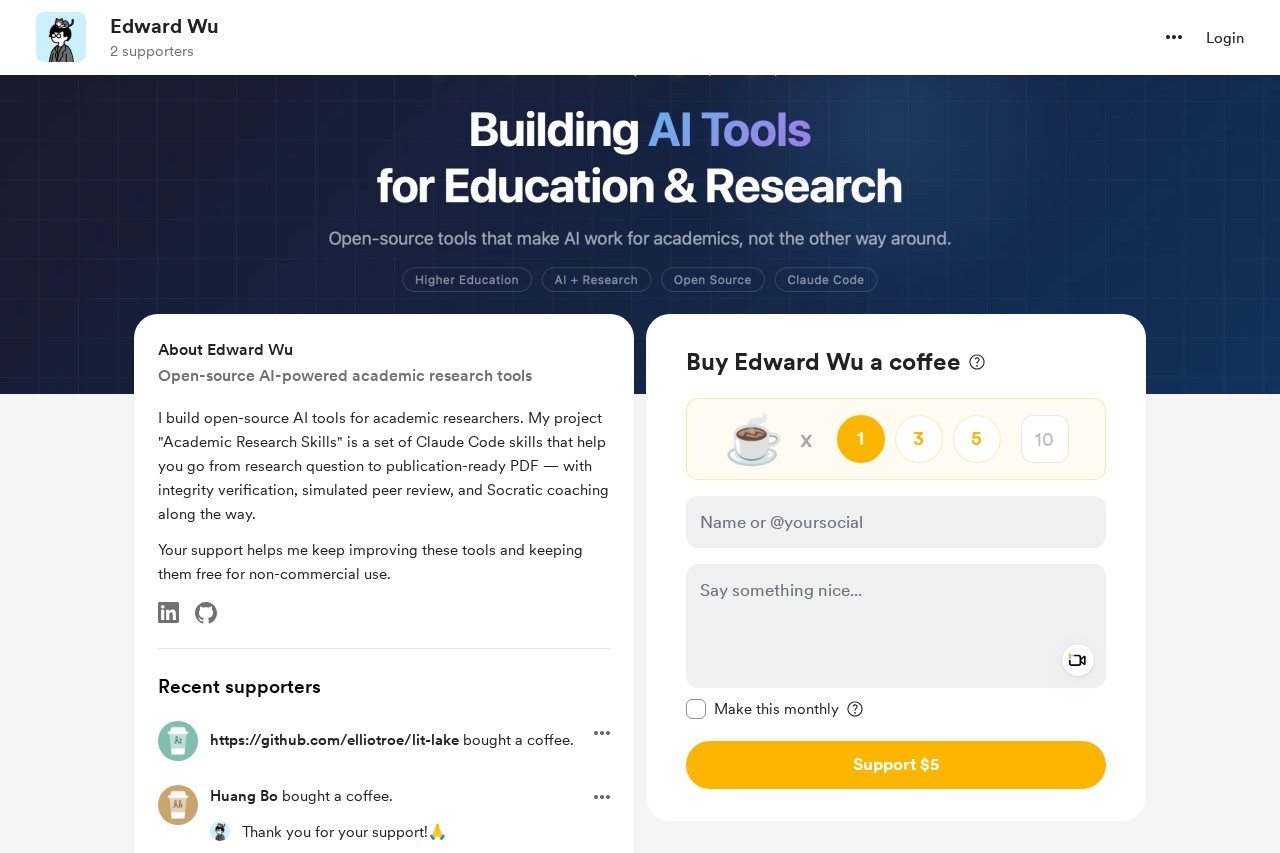
Edward Wu | AI Academic Research Tools is a platform dedicated to providing efficient, open-source solutions for academic researchers worldwide. Initiated by senior AI researcher Edward Wu, this project aims to break down the barriers of traditional academic writing and research by leveraging artificial intelligence to empower the complete workflow from "research question conception" to "publishable PDF output." At the core of the platform is a carefully designed set of Claude Code skills that help researchers automate tedious tasks such as literature review, data organization, draft generation, and formatting checks, allowing scholars to focus more energy on innovative thinking itself.
Key Features
- Full-process automated pipeline: From research question definition, literature retrieval, and abstract generation to paper structure building, paragraph writing, and reference formatting, ultimately outputting journal-compliant PDF files.
- Claude Code skill set: A collection of reusable AI instruction templates and workflows covering high-frequency scenarios such as paper writing, data analysis, academic translation, and peer review responses.
- Intelligent literature management: Automatically extracts, categorizes, and cites key references with one-click switching between multiple citation formats (APA, MLA, Chicago, etc.).
- Real-time collaboration and version control: Supports multi-user collaborative editing with complete revision history, ideal for team research and advisor guidance.
- Open source and customizable: All tool code and skill sets are released as open source, allowing researchers to adapt and extend them based on their specific field requirements.
Highlights
- Open source and free: Fully open source with no hidden fees, lowering the technical barrier to academic research.
- Deep AI integration: Built on large language models like Claude, delivering precise, academically rigorous text generation and comprehension.
- End-to-end experience: No need to switch between multiple software tools; one platform handles everything from conception to publication.
- Community-driven iteration: An active community of researchers and developers continuously contributes, keeping the skill sets and features updated and refined.
- Respect for academic ethics: All AI-generated content comes with traceable revision suggestions, guiding users toward critical review to ensure originality and academic integrity.
Who It's For
Master's and doctoral students can quickly complete course papers, thesis proposals, and dissertation drafts. University faculty and research staff can efficiently produce journal articles, grant applications, and technical reports. Independent researchers and freelance scholars gain access to high-quality academic writing assistance without institutional resources. Interdisciplinary teams can standardize writing style and formatting through unified AI workflows. Academic publishing editors can streamline manuscript processing with automated formatting and quality-check features.