Code-Graph-RAG - AI
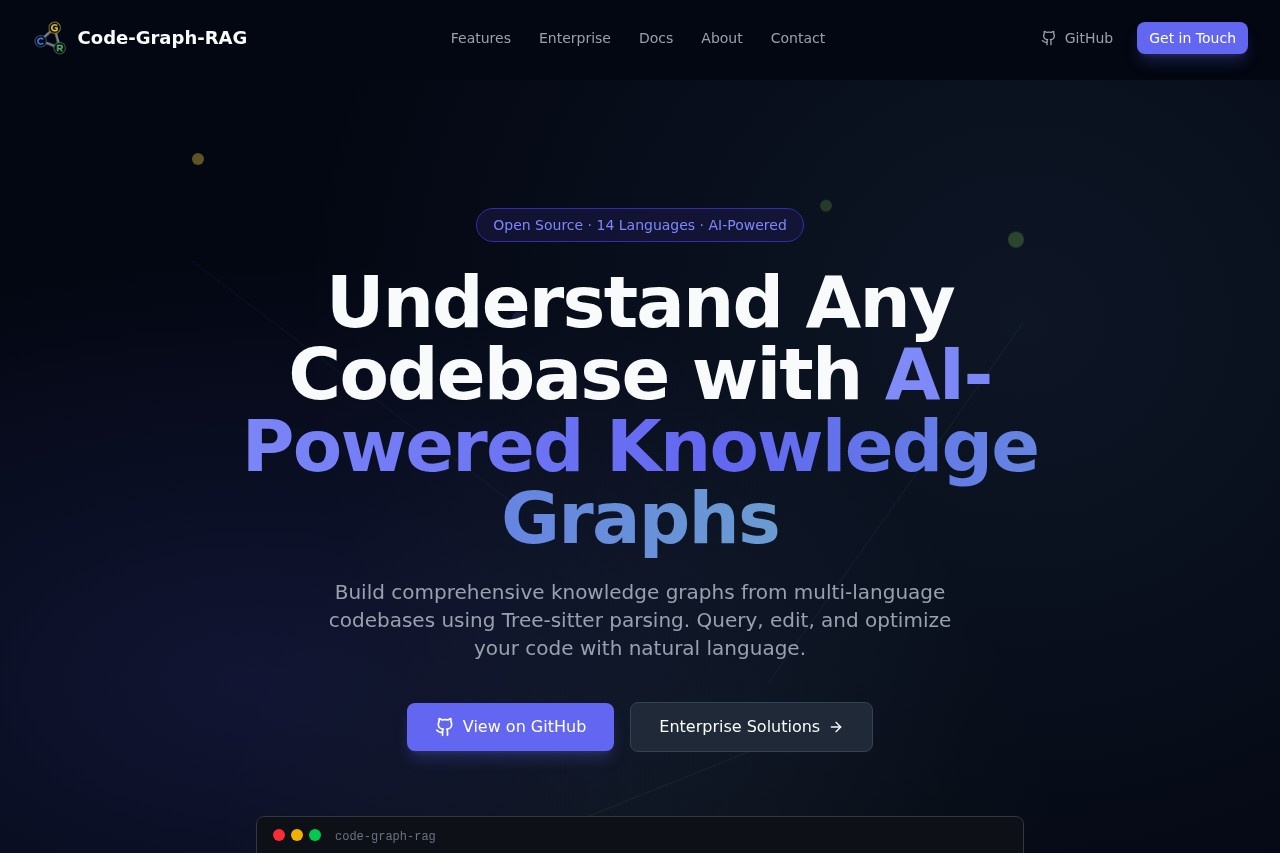
An AI-powered code repository analysis tool that builds a knowledge graph of code dependencies for precise search and question answering.
Introduction
In the software development process, understanding the structure and logic of a large codebase is often one of the most time-consuming and challenging tasks. Traditional search tools only provide surface-level matches, failing to reveal deep dependencies between modules. Code-Graph-RAG is designed to address this pain point—it is an AI-powered code repository analysis tool that leverages Tree-sitter to accurately parse multiple programming languages, automatically builds a code knowledge graph, and gives developers unprecedented insight. Whether dealing with a legacy project you've just inherited or a complex system under continuous iteration, Code-Graph-RAG transforms scattered code files into a structured semantic network, turning 'reading code' from an experience-based task into a reusable technical capability.
Key Features
The core capabilities of this tool revolve around 'understanding' and 'retrieval.' First, it supports multi-language parsing. Through Tree-sitter's incremental parsing mechanism, it accurately identifies the syntax structures of mainstream languages such as Python, JavaScript, Java, C++, and Go, extracting function, class, and variable definitions along with their call relationships. Second, it stores these relationships as a knowledge graph, where each code entity becomes a node and dependencies and references become edges, forming a navigable semantic map. Additionally, the tool includes an intelligent question-answering interface: developers can ask natural language questions like 'Which modules call this payment interface?' and the system generates precise answers based on graph context, along with relevant code snippets and path explanations.
Highlights
Compared to similar tools, Code-Graph-RAG has three significant advantages. First, high-precision parsing: Tree-sitter provides a fault-tolerant syntax tree. Even if code contains syntax errors or non-standard formatting, the graph remains intact, preventing a single file issue from causing overall analysis failure. Second, cross-language consistency: In projects with mixed technology stacks, it unifies entity representation across different languages, making cross-language call relationships clear at a glance—for example, how frontend JavaScript invokes backend Python services. Third, real-time updates: The tool supports incremental indexing. When a developer saves code, the graph automatically syncs and updates without manual rebuilding, ensuring retrieval results always reflect the latest code state.
Who It's For
If you are a software architect who needs to regularly assess system module boundaries and identify risks of circular dependencies or excessive coupling, this tool provides visual evidence. If you are a developer new to a project and feel overwhelmed by tens of thousands of lines of unfamiliar code, the knowledge graph can act as a 'living document' to help you quickly locate core entry points and key paths. If you are a tech lead who needs to assess the impact of changes during code review or refactoring planning, Code-Graph-RAG's relationship queries significantly reduce the risk of misjudgment. Furthermore, for automation operations and security audit personnel, tracing call chains of sensitive functions through the graph greatly improves work efficiency.