The Short Version
If your product makes the same call over and over — is this ticket urgent, which queue does this email go to, should this transaction be blocked — Jev deserves a hard look. If the answer needs to be invented rather than selected, keep walking.
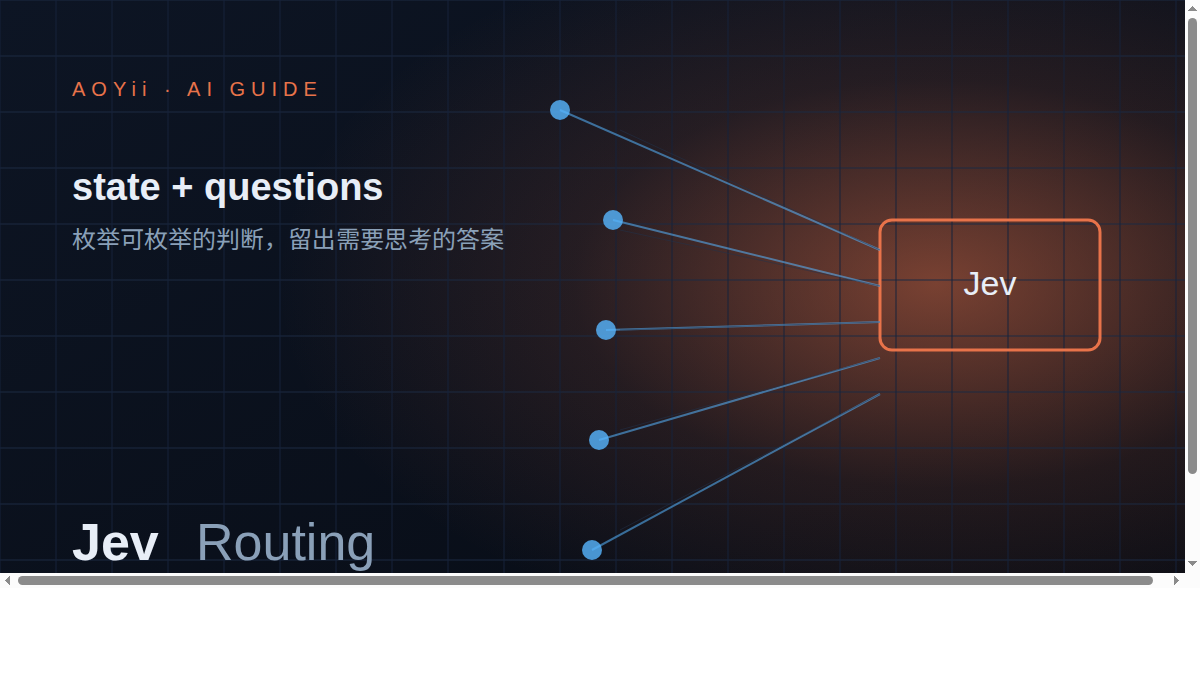
One sentence: Jev is a judgment engine that doesn't generate text. You hand it a state object and a list of questions; it returns a choice, a probability distribution, and a confidence score. Not one word of prose ever leaves it.
TypeSafe AI shipped it in mid-September 2026, leaning on Kahneman's System 1 / System 2 framing. Large language models are the slow, expensive System 2 that reasons and writes. Jev is built to be the fast, cheap System 1 that just looks and decides.
How It Actually Works
The API has exactly two concepts: state and questions. The state is context — nested JSON is fair game, including field references like ticket.message. The questions are what you want judged this round, and each one carries its own criteria.
Three question types cover the ground. Noul answers yes/no and returns a probability of truth, say 0.95. Choice picks among options and returns the winner with per-option probabilities and an overall confidence. Score rates on a scale and returns the value, the distribution, and a confidence figure.
Two execution details matter more than the taxonomy. First, every question on the same state runs in parallel — asking three things costs roughly the same wall clock as asking one. Full coverage stops being a sampling exercise. Second, the output is always a valid type: no prose where you expected an enum, no explanation glued to a number.
That last property is what the vendor means by "zero hallucination." It's a real guarantee, but a narrower one than the marketing implies — more on that below.
Where It Sits Against LLMs, Flash Models, and Classic Classifiers
A general-purpose LLM can think about anything and bills you for the privilege. A Flash-tier model cuts cost and latency by an order of magnitude but is still generative — you still parse, retry, and defend against malformed output. A classic classifier (logistic regression, a fine-tuned BERT) is cheap and type-safe, but each one handles exactly one task; change the label set and you're back to annotation and retraining.
Jev occupies the gap between them. It has a classifier's cost structure and type guarantees with something close to an LLM's flexibility, because the judging criteria live in the question text. Changing requirements means editing a line, not shipping a new model.
The dividing rule fits in one breath: if the answer can be enumerated from a finite set of options, give it to Jev; if the answer has to be thought up, give it to an LLM. Most products contain both kinds of decisions, so the real win is shrinking what you send to the LLM — not picking one tool forever.
What "Zero Hallucination" Does and Doesn't Mean
The vendor's claim covers exactly one thing: format integrity. The type error rate is zero — the output is always the boolean, enum, or score you asked for. That is genuine engineering value; it deletes an entire layer of defensive parsing from your pipeline.
It does not mean the judgment is always right. An urgency call can be wrong, a risk score can be off — the failure mode is a bad probability, not confident nonsense about events that never happened. Reading "zero hallucination" as "zero mistakes" is the most common and most expensive misinterpretation here.
The correct contract treats confidence as a first-class citizen. Every answer ships with a probability distribution and an overall confidence figure, so you set thresholds: auto-execute above the line, route to a human below it. Judgments will be wrong; the threshold is what keeps wrong ones from acting.
A Decision Framework: Enumerate, Gate, Volume
Run any "should we adopt this" debate through three questions. All three must come back yes.
Enumerate. Is the answer naturally a finite option set — yes/no, one-of-four, a 0-to-5 rating? If it's open text, you're done here.
Gate. Can this decision be intercepted? If you can draw a confidence threshold and hand the uncertain cases to a person instead of auto-executing, you have a safety boundary. If every call must be fully autonomous, think again.
Volume. Is the decision frequent enough that cost or latency already hurts? The vendor's benchmark puts a single decision around $0.000081 and 0.114 seconds, versus roughly $0.014 and 8.6 seconds on an LLM. Two orders of magnitude is real — but if you make a hundred calls a day, two orders of magnitude still buys you lunch, not a headcount.
One gray-zone rule to add: if you can't articulate the criteria yet, run the judgment through an LLM first and let the pattern emerge, then freeze it into a Jev question. Jev amplifies rules you already understand; it does not write them for you.
The Framework Applied
Ticket triage is the textbook case. One ticket arrives; urgency, department routing, and sentiment are evaluated in parallel, across your entire volume rather than a sample. At 0.114 seconds a call, triage happens the instant a ticket lands instead of waiting in a batch queue.
Refund compliance shows off the state format: pack the ticket, the order record, and the relevant policy clauses into one state and judge all three dimensions in a single pass. What you save isn't just money — it's collapsing three rule chains into one probabilistic verdict you can threshold.
Account risk scoring and real-time transaction screening live and die by latency; nothing over 100 milliseconds survives inside a transaction path. Browser agents care about the other axis — cheaply gating a risky action, like executing a shell command, before it fires.
The counterexamples matter just as much. Math reasoning tops out around a previous-generation flagship LLM, so don't bother. A 32K context window means long documents need slicing first. No image input at all. Each of those sends you back to a general model.
What To Do Monday
Adopt it for: high-frequency classification and triage (tickets, email, moderation, log routing); judgments currently running on an LLM where cost or latency has become a line item; gating inside agent workflows. Write criteria with real teeth — "urgent = production impact, ongoing over 24 hours, or money involved," not "urgent = sounds upset."
Skip it for: open reasoning and generation, anything needing vision, exploratory problems where the criteria are still fuzzy, and low-volume calls where a 100x saving rounds to nothing.
Evaluate with care: the ecosystem is young. The LangChain package and the web console are in early access, and the vendor's benchmarks haven't been independently verified. Input-only pricing — roughly $42 per billion tokens, with output free — smells like subsidy; have a fallback priced out before you architect around it.
Getting started is cheap, which lowers the stakes. Both Cloudflare Workers AI and OpenRouter serve the model, and the LangChain middleware includes a router that dispatches each judgment to the cheapest model capable of handling it. Start with the single most painful judgment in your product — usually the one you've wanted on an LLM but flinched at the invoice — verify the probability quality against your own labeled cases, then expand.