The Move Nobody Expected
In mid-September 2026, a startup called TypeSafe AI shipped a model named Jev with its most radical setting switched off: the ability to talk.
Not "talks less." Never talks. It returns structured decisions with probabilities — a routing choice, a score, a pass/fail verdict — across three problem types. The tagline is "Decisions, not strings."
In an industry where every model competes on eloquence, refusing to speak looks like self-sabotage. I'd argue it's the most honest bet in seventy years of AI, and the signal most people are scrolling past.
How the Industry Optimized the Wrong Variable
Start with the Turing test. It defined intelligence as "fooling a human in conversation," and for seven decades that anchored the field's objective function: sound smarter, sound more human.
Language, though, is the thinnest skin intelligence ever grew — a late evolutionary overlay, maybe a few hundred thousand years old. A surgeon has already decided before saying "suture." Most consequential decisions are finished before a single word is spoken.
Then RLHF doubled down on the skin. Training against human preference yields preference-collapse: models that say what looks right, overconfident on their own calibration, probabilities you can't trust for automation.
The deeper truth is uncomfortable: you get what you optimize for, and strings are the hardest thing to optimize. Optimizing language buys you rhetoric. Jev's founders essentially conceded the road was impassable and changed the objective — from how it says to what it decides.
A Framework: The Intelligence Grid
Here's a transferable mental model — call it the intelligence grid. Treat intelligence like a layered power system, each tier with its own voltage, cost, and latency:
- Frontier tier — high voltage. Hard reasoning, expensive, slow, highest energy density.
- Flash tier — mains power. Ordinary reasoning at commodity prices, carrying the daily load.
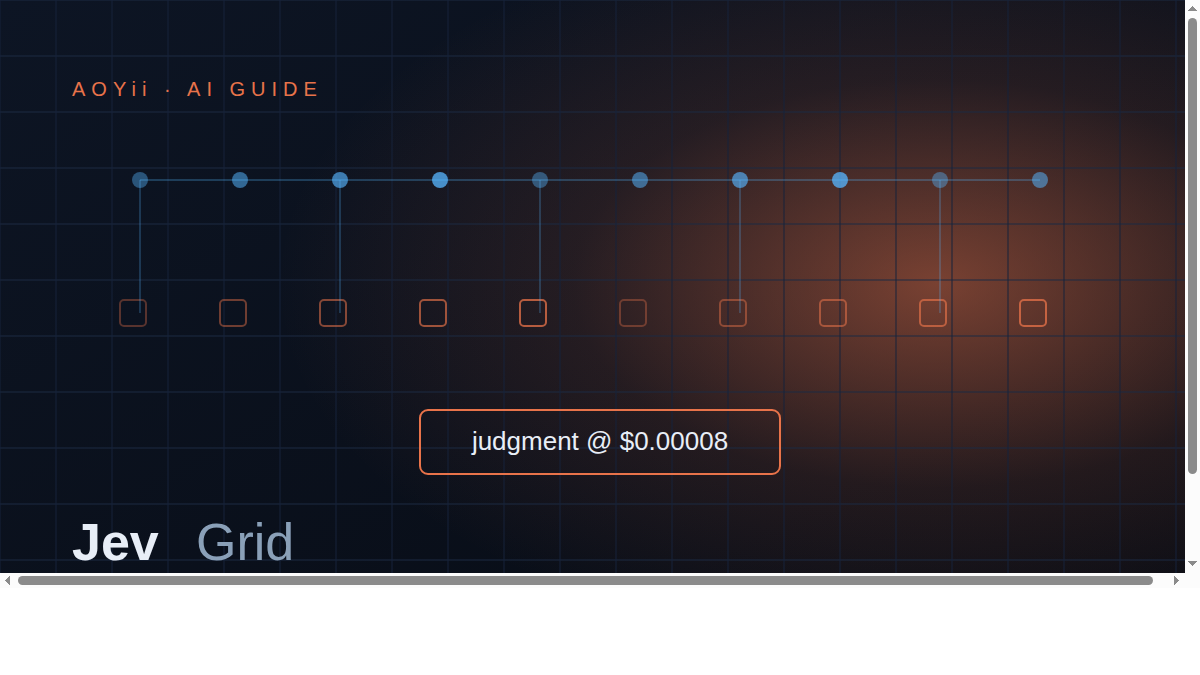
- Decision tier — pulse power. High-frequency judgment: routing, classification, verification, scoring, priced at five decimal places per call.
- Deterministic tier — the wiring itself. Plain if-else code: zero intelligence, zero risk.
No tier is "the smartest." A grid works by matching load to voltage, with a harness as the dispatcher routing every unit of intelligence where it belongs. That's the audit question for any AI architecture: not "which model is best" but "which tier does each decision belong on — and is the dispatcher honest about confidence?"
Jev's bet isn't a smarter model. It's proving the fourth tier exists.
What Happens When Judgment Tends Toward Zero
Software. When routing, classification, and verification become inlined calls, intelligence seeps into code the way electricity seeped into buildings — not an LLM bolted onto every function, but a probabilistic judgment beside every branch, cheap enough to invoke carelessly.
Agents. A well-calibrated decision model becomes the router and confidence gate: high confidence executes automatically, medium confidence escalates to a frontier model, low confidence routes to a human. The reliability bottleneck shifts from "how smart is the model" to "how precise is the triage."
The economics. TypeSafe's own benchmarks report $0.000081 and 0.114 seconds per decision versus roughly $0.01388 and 8.566 seconds for an LLM call — about 194× faster and 445× cheaper. Treat those numbers critically: the eval tasks were designed in-house, reference answers were partly generated by strong models, and no public paper, parameter count, or ablation exists. The honest baselines — a Flash model with constrained decoding, a classic classifier, an embedding classifier — haven't been raced yet.
Demand. This is where the name earns its keep. Jevons paradox: when efficiency drives cost down, total consumption explodes rather than shrinks. Early traction rhymes with it — $0.042 per million input tokens with free output, over 161 billion tokens processed on OpenRouter within days, 140,000 developers in 36 hours, and Gemma's own follow-up, DiffusionGemma as Jev.
The critique. Be precise about what "zero hallucination" means here: type safety, not correctness. Feed it a cat, get back "dog, 97% confidence" — no type error raised, business logic wrecked anyway. Math reasoning sits near GPT-4 level, there's no image input, and context is capped at 32K. A decision layer you can't calibrate is just another talkative model.
What To Do Monday Morning
If you build systems: audit every place an LLM "talks" in your stack and list the judgments underneath — the routings, classifications, verifications, scores. Ask which of them should be pulse power.
If you fund them: stop asking how smart a model is; ask for its calibration error. RLCD-style training — where predicted probabilities must bite into real hit rates — is the actual moat, and it's also the tell separating a decision layer from a marketing layer.
If you research them: build the missing independent benchmark. Until a decision model beats constrained decoding and embedding classifiers on someone else's tasks, every multiplier is a vendor's number.
Here's the thesis, stated plainly. For seventy years we optimized how machines speak. Jev bets on how they decide. When judgment's cost trends to zero, intelligence stops being a capability you summon and becomes a current running through software's crevices — invisible at the surface, load-bearing underneath.
The quietest sign of a paradigm shift is that it stops talking.
One Misreading To Avoid
The tempting read is "small models replacing big models." That misses the point: the grid has no replacement, only layers. Frontier models don't disappear — their existence is exactly what lets a decision tier specialize in short, cheap judgment.
The second tempting read is "isn't this just a classifier?" Depends where you stand. From the model's side, sure. From the system's side, it's the first component that ships uncertainty itself as a primitive: a classifier emits labels, a decision model emits probabilities that a harness can act on with confidence-based triage. One is a switch; the other is a transformer.
One caveat cuts against my own enthusiasm: every startling number about Jev currently has a single narrator. The real paradigm signal won't be launch-day buzz — it will be whether independent evaluations can reproduce that 445× cost gap six months from now. Until then, bet on the direction, not the multipliers.