AI Guide
Comprehensive AI guides, tutorials, and learning resources.

Token Economics: The First Meter for Intelligence
Every AI pricing page reduces to the same unit: dollars per million tokens. Most people read that line as a billing rule — a cost item to be optimized away. That reading is too narrow, and it quietly misprices the biggest economic shift of this decade. The argument of this piece is simple: the token is the first unit in history that lets us buy, meter, and bill the output of intelligence …
Read more →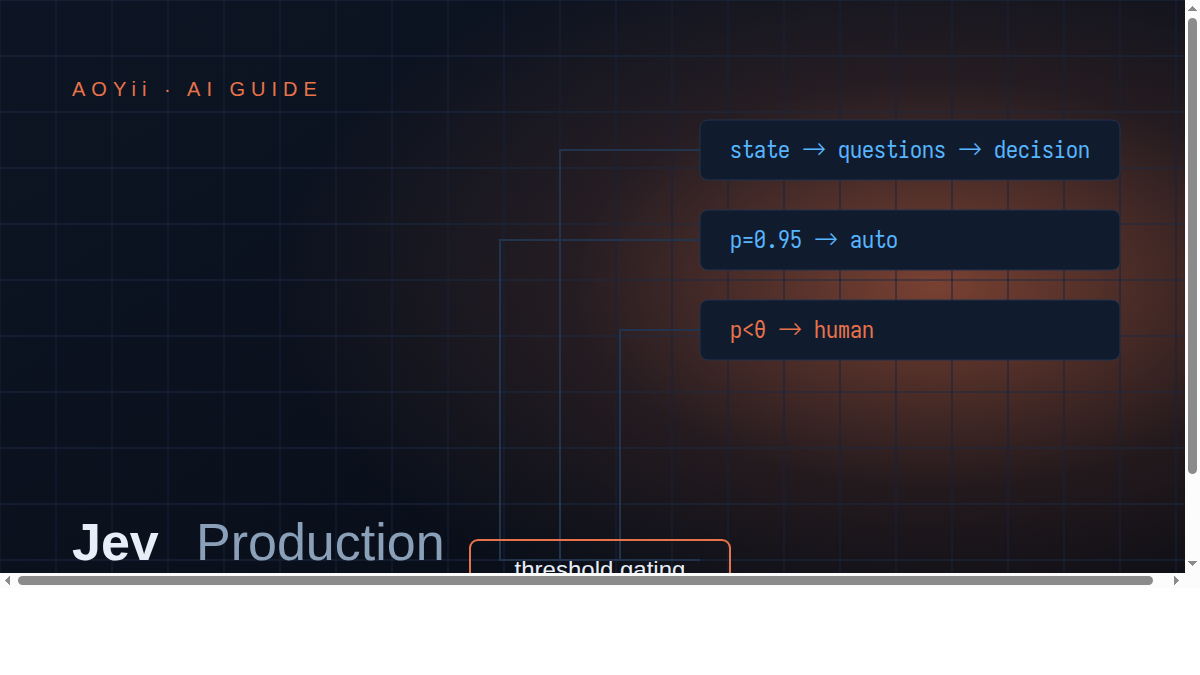
Jev in Production: Shipping a Fast, Cheap Judgment Model
Start With the Right Mental Model TypeSafe shipped Jev on September 15, 2026, and the pitch sounds contradictory: it's an AI model that generates no text. Call it a System One Model — a deliberate nod to Kahneman. Where a reasoning LLM is slow, expensive System Two, Jev is fast, cheap pattern recognition. The official numbers frame the gap: a single decision costs $0.000081 and completes …
Read more →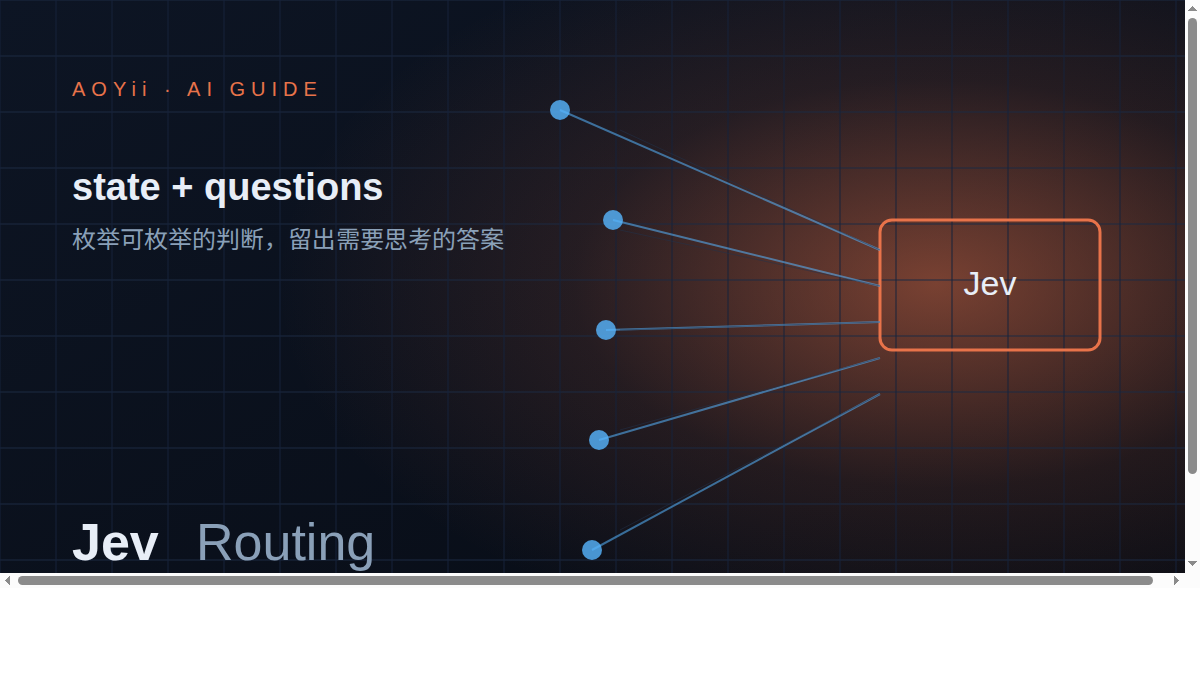
Jev: When to Use the Judgment Engine That Never Writes a Word
The Short Version If your product makes the same call over and over — is this ticket urgent, which queue does this email go to, should this transaction be blocked — Jev deserves a hard look. If the answer needs to be invented rather than selected, keep walking. One sentence: Jev is a judgment engine that doesn't generate text. You hand it a state object and a list of questions; it returns …
Read more →
Harness Beats Model: The Real Variable in AI Agent Performance
Start with the consensus view: agent capability is a property of the model. Want a better coding agent? Wait for the next release. That assumption made sense in 2023, when frontier models were separated by wide gaps. It no longer survives contact with the numbers. On SWE-bench Verified, six frontier models — Claude Opus 4.5 and 4.6, Gemini 3.1 Pro, MiniMax M2.5, GPT-5.4, and Sonnet 4.6 — …
Read more →AI Harness vs Model: Why the Same Model Scores 36 Points Apart
One Model, Two Harnesses, a 36-Point Gap On September 3, ARC Prize published a strange set of results for ARC-AGI-3, one of the hardest reasoning benchmarks available. The same model — GPT-6 Astra, at the same reasoning effort — was run through two different harnesses. In the standard harness it scored 62.7%. In the Provider Adapter harness, it scored 98.6%. The cost curve is even more co …
Read more →
Grade Agentic Worker: How Office AI Agents Are Tiering Up in 2026
The popular assumption: office AI agents are one homogeneous product category, and picking between Copilot, Gemini, Manus, or Genspark is a matter of brand preference — similar features, similar $20 price tags. That assumption does not hold. In 2026, the office agent market has split into clear tiers. These are not the same product under different brands; they are three different grades o …
Read more →
Run 35B MoE Models on an RTX 4060 with FreeToken
Researchers from UC Berkeley and MIT just open-sourced FreeToken, an inference engine that runs frontier Mixture-of-Experts (MoE) models on consumer hardware. On an 8GB RTX 4060 laptop it serves Qwen3.6-35B at roughly 39 tokens/second; on an RTX 5090 it handles DeepSeek-V4-Flash (284B). The idea: treat your PC as an elastically schedulable heterogeneous compute pool instead of a resource- …
Read more →Reinforce Only What the Robot Actually Did: Inside SmoothRL's Async Online RL
Robot foundation models keep getting bigger, which means slower inference. Real deployments hide that latency with asynchronous inference: the robot keeps executing the current action chunk while the model computes the next one. It's smooth, it's necessary — and it quietly breaks online reinforcement learning. Here's the problem. With async execution, the actions the model planned and the …
Read more →Train a Biped Robot With RL: Getting Started With Microduck
Microduck is a 25 cm, 800 g open-source biped robot from Pollen Robotics (Hugging Face) that ships with seven pre-trained moves — walking, sitting, kicking, grabbing with its beak, roller-skating, and standing back up after a fall. What makes it worth your time as a developer isn't the cuteness: the entire software stack is on GitHub under Apache-2.0, and you can train new gaits yourself …
Read more →Archify: Generate Architecture Diagrams from Any Codebase
Use the Archify agent skill to turn any codebase into interactive, verifiable architecture diagrams in Claude Code, Cursor, Codex, OpenCode.
Read more →Detect LLM Hallucinations with HCPD: Zero-Source, 88% AUROC
Detect LLM hallucinations with just the Q&A pair: HCPD (ICML 2026) hits 88.19% AUROC on Llama-3.1-8B; code open source on GitHub.
Read more →How to Make Videos With OpenAI Codex: A Step-by-Step Guide
Make videos with OpenAI Codex: Remotion code-first workflows, Hyperframes connectors, and pro tips for shipping motion graphics fast.
Read more →