Warp
NVIDIA's advanced technology.
Introduction
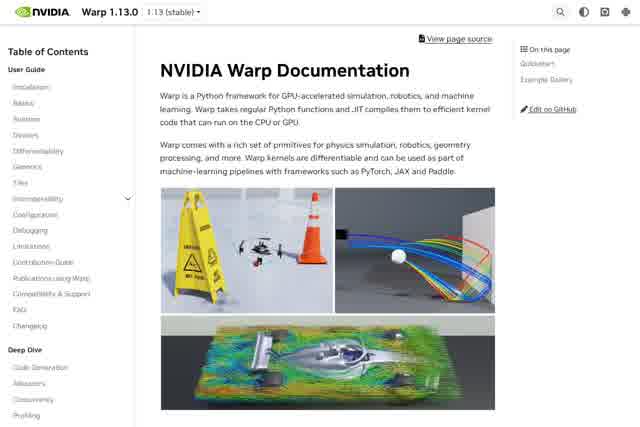
Warp is a high-performance graphics and simulation framework developed by NVIDIA, designed to accelerate next-generation compute graphics, physics simulation, and artificial intelligence workloads. As a key technology component within the NVIDIA ecosystem, Warp provides developers with an efficient, programmable runtime environment that fully leverages GPU parallel computing capabilities for a wide range of scenarios, from real-time rendering to complex scientific simulation. Whether in game development, visual effects, industrial design, or robotics simulation, Warp significantly improves the efficiency of graphics processing and physics computation, helping developers break through traditional performance bottlenecks.
Key Features
- High-performance graphics rendering pipeline: Supports modern graphics APIs including Vulkan, DirectX 12, and Metal, with advanced features such as ray tracing and mesh shaders for cinematic real-time rendering.
- Physics simulation engine: Integrates rigid body, soft body, fluid, and particle system simulation, with collision detection and constraint solving for game physics, virtual reality, and industrial simulation.
- AI-accelerated computing: Seamlessly integrates NVIDIA CUDA and TensorRT, supporting neural network inference and training for AI-driven applications such as agent control and scene understanding.
- Multi-GPU and distributed computing: Natively supports multi-GPU collaboration and cluster deployment, with linear scaling of compute performance for large-scale simulation needs.
- Dual Python and C++ APIs: Provides an easy-to-use Python interface for rapid prototyping while retaining low-level C++ interfaces for maximum performance control.
Highlights
- Extreme performance optimization: Deeply optimized for NVIDIA GPU architectures, leveraging dedicated hardware such as Tensor Cores and RT Cores to deliver up to tens of times the performance of traditional solutions.
- Cross-platform compatibility: Supports Windows, Linux, and cloud environments, with flexible deployment across workstations, data centers, and edge devices.
- Open ecosystem: Deeply integrated with NVIDIA Omniverse and Isaac Sim, while remaining compatible with mainstream 3D tools such as Blender, Unreal Engine, and Maya.
- Low-latency real-time interaction: Achieves millisecond-level response through asynchronous compute and streaming technologies, ideal for VR/AR, digital twins, and other real-time interactive scenarios.
- Developer-friendly: Provides extensive sample code, documentation, and debugging tools to flatten the learning curve and accelerate project delivery.
Who It's For
Game developers looking to build high-fidelity, high-frame-rate 3D games or implement complex physical interactions. Film and animation artists pursuing photorealistic rendering and effects simulation while reducing offline render times and boosting production efficiency. Industrial engineers and scientists working on simulation and analysis in fields such as fluid dynamics, structural mechanics, and electromagnetics who need both high accuracy and fast computation. Robotics researchers training and testing robot algorithms in virtual environments for seamless sim-to-real transfer. AI and computer vision developers who need GPU-accelerated neural network inference or want to build hybrid applications combining graphics and AI.