OpenViking - The Context File System for AI Agents
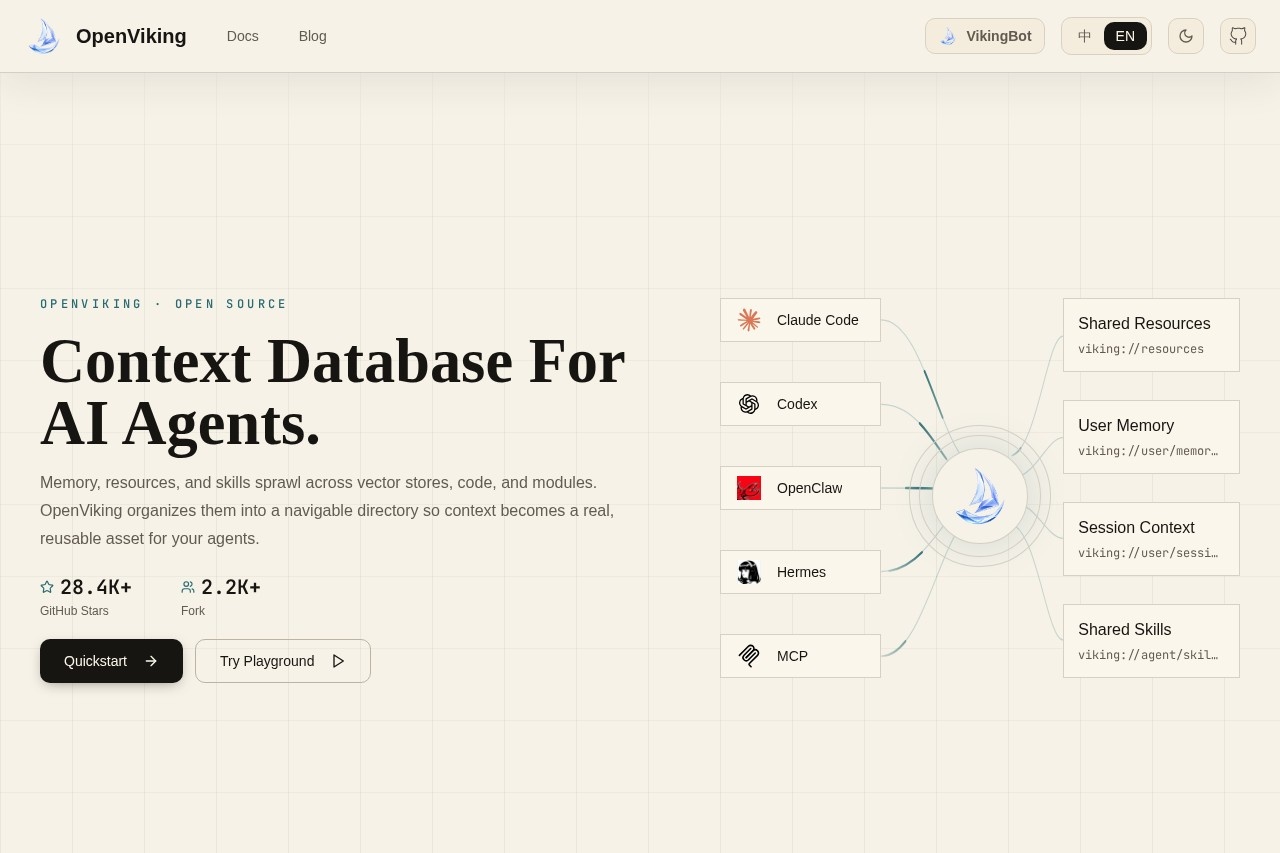
OpenViking provides a context file system for AI agents, using LOD to manage and retrieve relevant information efficiently.
Introduction
OpenViking is a context file system designed for next-generation AI agents. It fundamentally changes how AI agents manage context by unifying memory, resources, and skills into a file system paradigm. Through the concept of "context as files," OpenViking enables AI agents to efficiently manage their own state, load external knowledge, and invoke tools just as humans operate folders. The system natively supports the LOD (Level of Detail) supply mechanism, allowing agents to dynamically adjust context depth based on task complexity, thereby enabling self-iteration and continuous evolution.
Key Features
- Unified context management: Memory, resources, and skills are presented in a file/directory structure, eliminating fragmented storage and improving retrieval efficiency.
- LOD hierarchical supply: Supports on-demand loading of context details, delivering content layer by layer from summaries to full data, reducing token overhead.
- Self-iteration mechanism: Agents can read their own context files, identify knowledge gaps, and automatically supplement or update memory and skills.
- Multi-agent collaboration: Enables context synchronization and task handoff between multiple agents through a shared file system namespace.
- Plugin-based skill library: External tools are encapsulated as "executable files," and agents gain new capabilities simply by mounting them.
Highlights
- Minimal abstraction: Developers do not need to learn complex APIs; understanding file read/write operations is enough to control agent context.
- Strong observability: All context changes are recorded as file logs, making debugging and auditing straightforward.
- Elastic scalability: Supports local storage, cloud storage, and distributed file systems, adapting from personal applications to enterprise-level clusters.
- Low-coupling design: Model-agnostic and compatible with any agent framework, including GPT, Claude, Llama, and others.
- Resource efficiency: The LOD mechanism significantly reduces irrelevant context passing, saving inference costs and response time.
Who It's For
OpenViking is built for AI application developers who need to create persistent memory and dynamic skill systems for agents, RPA teams looking to replace traditional scripts with AI agents for complex multi-step tasks, knowledge management researchers exploring file-system-based organization of large model knowledge and experience, enterprise architects designing multi-agent collaboration systems that require auditable, rollback-capable, and version-controlled context, and independent developers or enthusiasts who want to quickly build a personal AI assistant with self-evolution capabilities.