OpenAI - PyPI
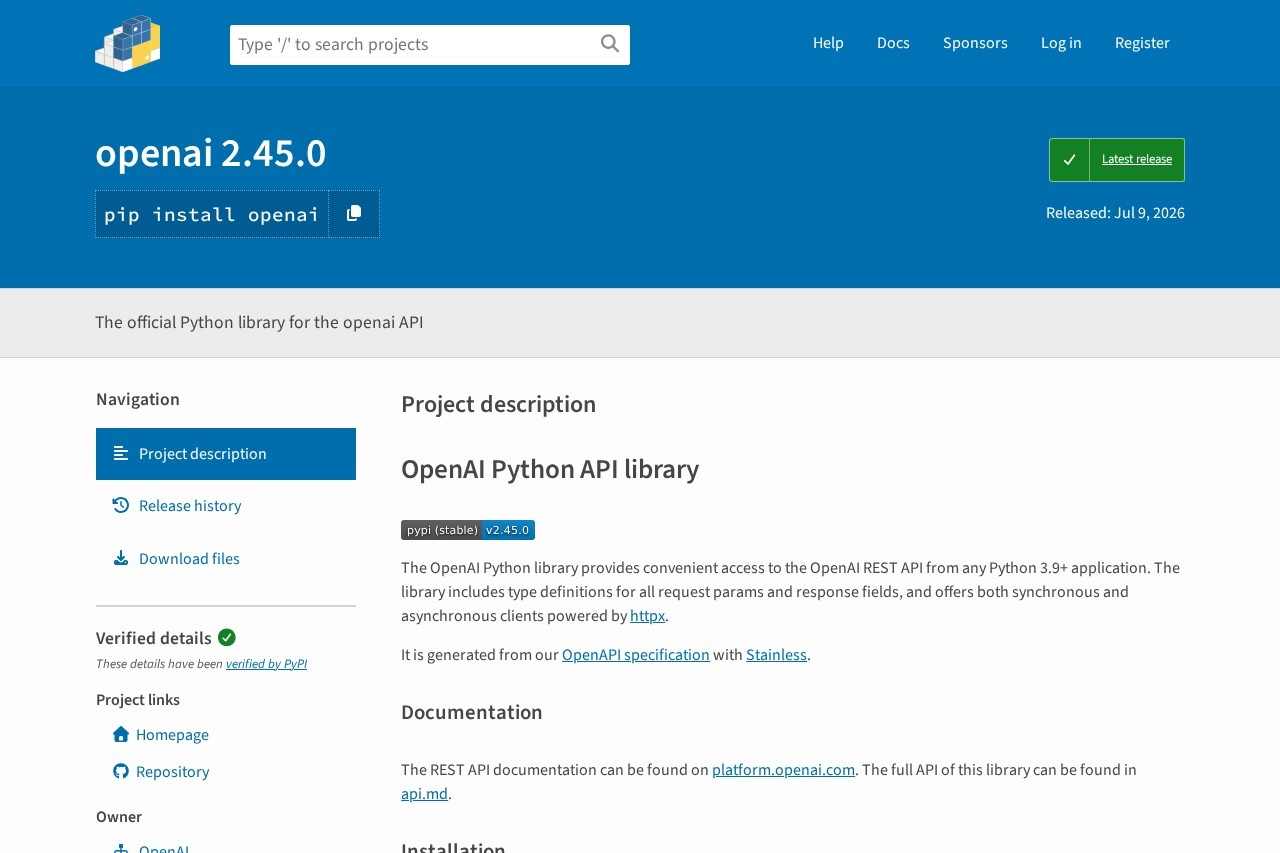
The official Python library for the OpenAI API.
Introduction
openai is the official Python library provided by OpenAI, designed for developers to conveniently access OpenAI's various artificial intelligence models and services. As one of the most popular AI-related packages on PyPI, it wraps the interaction interfaces for models such as GPT, DALL·E, and Whisper, allowing developers to quickly integrate powerful natural language processing, image generation, and speech recognition capabilities using clean Python code. Whether you are building a chatbot, automating content generation tools, or performing data analysis, the openai library offers stable and efficient official support.
Key Features
- Text generation and conversation: Call GPT series models (such as GPT-4 and GPT-3.5) for intelligent Q&A, text continuation, summarization, and more.
- Image generation and editing: Use DALL·E models to generate images from text descriptions, or perform inpainting and variation creation on existing images.
- Speech-to-text: Leverage Whisper models to accurately transcribe audio files or real-time speech streams into text, with support for multiple languages.
- Embedding computation: Obtain semantic embeddings of text for downstream tasks such as similarity comparison, clustering, and search.
- Fine-tuning management: Upload training data to create custom fine-tuned models, and manage the status and results of fine-tuning jobs.
Highlights
- Officially maintained and reliable: Continuously updated by the OpenAI team, ensuring immediate compatibility with the latest models and API changes, avoiding third-party library issues.
- Simple interface, quick to learn: Designed following Python best practices, requiring only a few lines of code to complete an API call, significantly lowering the development barrier.
- Async support: Provides an asynchronous client (AsyncOpenAI) suitable for high-concurrency scenarios, improving application performance.
- Comprehensive error handling: Built-in clear exception classes help developers quickly diagnose authentication, rate limiting, parameter errors, and other issues.
- Rich documentation and examples: Official API docs, migration guides, and code samples support fast integration into existing projects.
Who It's For
Python developers who want to quickly add AI capabilities to web applications, desktop software, or scripts. Data scientists and researchers who need embeddings and fine-tuning for natural language processing or generative AI experiments. Product managers and entrepreneurs who want to evaluate AI capability prototypes and accelerate products from concept to launch. Educators and students who are learning AI programming, building teaching demonstrations, or completing course projects.