Herdr: One Terminal for the Whole Herd
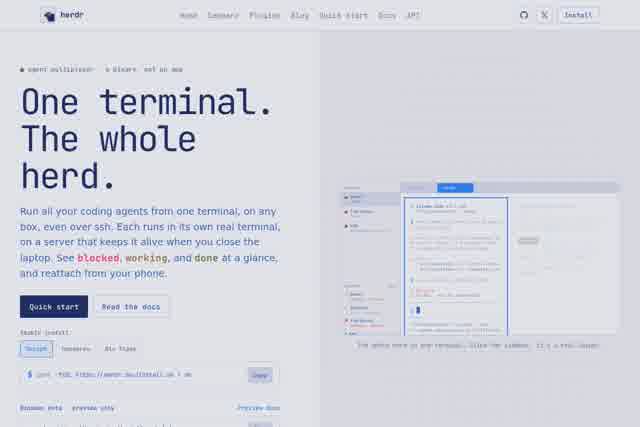
Herdr is to coding agents what tmux is to terminals: an agent multiplexer that runs where your agents run. Real panes, agent state at a glance, ssh from anywhere, no app.
Introduction
As AI development tools evolve at breakneck speed, efficiently managing multiple coding agents has become a core challenge for developers. Herdr was built to solve exactly this problem—it is an "agent multiplexer" designed specifically for coding agents, playing a role similar to what tmux does for terminal management. Herdr runs right where your agents run, letting you monitor, control, and orchestrate multiple agents from a single unified interface—no desktop app required, and accessible from anywhere over SSH.
Key Features
- Real pane management: Run multiple agents in parallel, each with its own dedicated pane that you can switch, rearrange, and resize just like terminal panes.
- Agent status at a glance: View real-time status, task progress, resource usage, and output logs for every agent, making it easy to spot issues or evaluate performance.
- Remote SSH access: No client or desktop app needed—connect securely to your agent cluster from any device via SSH and manage everything from anywhere.
- Zero extra dependencies: Herdr is lightweight and self-contained, running directly on your server or dev machine without requiring a graphical interface or third-party platform.
Highlights
- Minimal architecture, maximum efficiency: Herdr strips away bulky GUIs and complex configuration, focusing purely on core agent orchestration while keeping resource usage to a minimum.
- Native terminal experience: For developers who live in the command line, Herdr's workflow feels almost identical to tmux, so the learning curve is nearly zero—just start using it.
- Secure and controllable: All communication runs over encrypted SSH tunnels, and agent data never leaves your server, fully meeting enterprise requirements for data privacy and compliance.
- Cross-platform compatibility: Supports Linux, macOS, and any Unix-like environment, deploying seamlessly on local dev machines or cloud servers alike.
Who It's For
AI and machine learning engineers who need to run multiple training or inference agents simultaneously and monitor their behavior in real time. DevOps and SRE teams managing large fleets of automation agents who want a unified entry point for remote orchestration and troubleshooting. Independent developers and power users who prefer lightweight toolchains and want to drive multiple coding assistants efficiently on low-spec machines or in pure terminal environments. Research institutions and labs that need to batch-manage experimental agents while maintaining fine-grained control over system resources.