Caveman - Reduce Token Usage by 65%
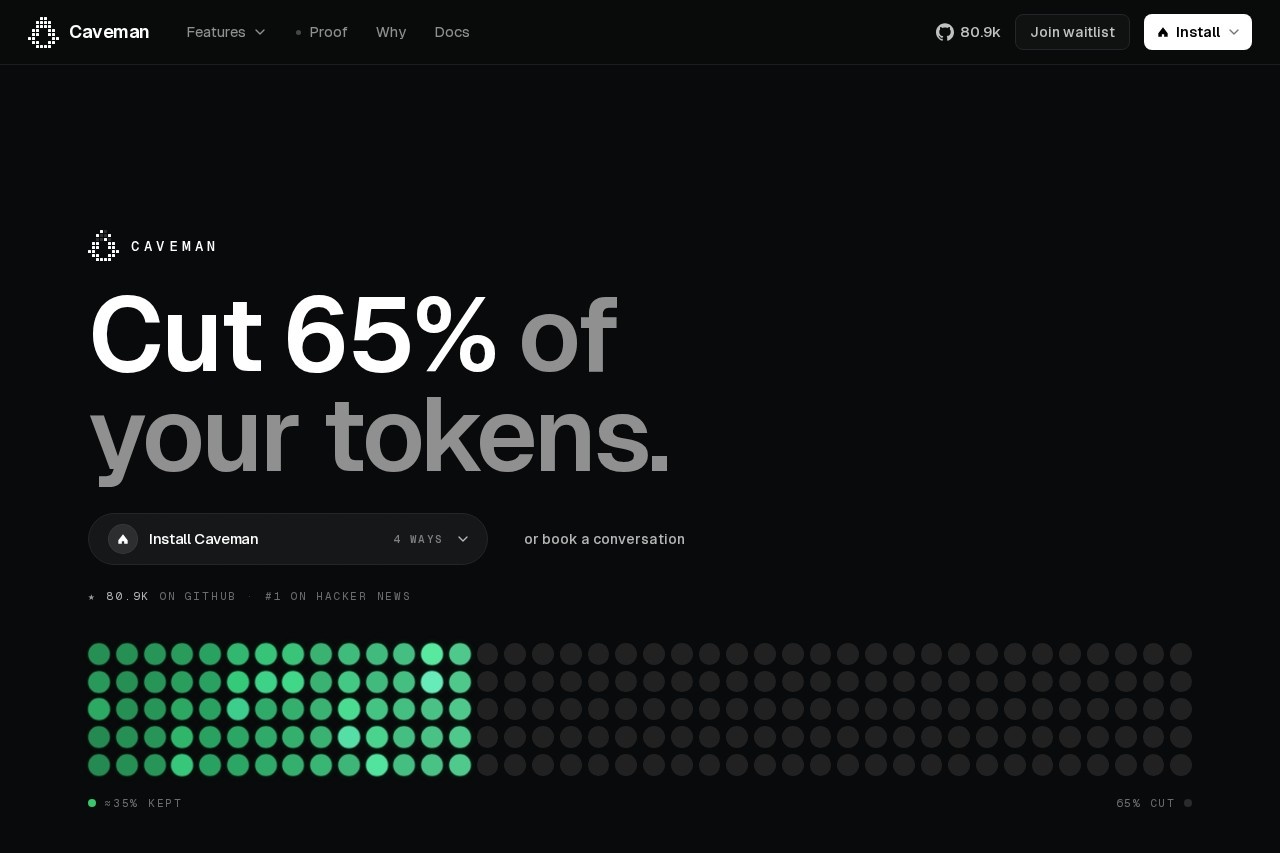
Caveman optimizes AI prompts to cut token usage by 65%, saving costs. Compatible with Claude Code, Cursor, Windsurf, Cline, and 30+ agents. GitHub 74k+ stars.
Introduction
Caveman is an open-source optimization tool stack for AI coding agents, built around one simple philosophy: "Why use many token when few token do trick" — making AI output as concise as a caveman. It started as a Claude Code skill plugin that dramatically cuts token consumption by changing how AI responds (lean, direct, no fluff), and has since evolved into a full-stack solution spanning five layers including a gateway, memory layer, and terminal agent. The project has earned 74k+ stars on GitHub, once hit #1 on Hacker News, and is supported by 30+ mainstream AI coding agents including Claude Code, Codex, Gemini, Cursor, Windsurf, Cline, and Copilot. Core author Julius Brussee has fully open-sourced it under the MIT license, with a managed cloud service available at caveman.so.
Key Features
- Caveman Skill Plugin: Compresses AI coding agent responses from verbose explanatory text into blunt, precise "caveman-style" replies, reducing output tokens by roughly 65-75% on average while maintaining full technical accuracy.
- Caveman Code (Terminal Agent): An npm-installable terminal AI agent with built-in four-layer compression, support for 20+ model providers, plan-then-execute workflow, and single-turn autonomous loops that cut token usage by about half.
- Caveman Gateway (Traffic Compression Gateway): Coming soon — replace a single base URL to compress all LLM traffic with zero changes on the agent side, plus real token-level billing.
- Cavemem (Persistent Memory Layer): A recall layer delivered via MCP protocol, built on local SQLite + FTS5 + vector indexing, retrieving only necessary information instead of resending full context.
- Cave Architect (Cost Insights): Turns telemetry data into a prioritized optimization roadmap, tagging each change with its dollar-per-day cost impact to help teams make better decisions.
- Evaluation-Gated Releases: Every optimization must pass evaluation tests before shipping, and any change that degrades quality is automatically rolled back — so savings never come at the cost of quality.
Highlights
- Real token savings: 65% average reduction in output tokens, backed by transparent, public benchmark data.
- Zero-friction integration: In Caveman Gateway mode, just swap one base URL — all existing agents keep working untouched.
- Fully open source: MIT-licensed, so you can audit, modify, and deploy it yourself.
- Community-proven: 74k+ GitHub stars, Hacker News front page, and production deployments at multiple companies.
- Quality assurance: Evaluation gating ensures compression never hurts code quality, with automatic rollback of failed optimizations.
Who It's For
Heavy AI coding users who rely on tools like Claude Code or Cursor daily and want to cut API costs. Development teams that can set up Caveman Gateway once and let the whole team enjoy automatic token compression without per-developer configuration. AI agent developers building custom agents who want to integrate Caveman's compression and memory capabilities. And token-budget-sensitive teams — startups and indie developers — who need precise control over AI API spending.