Taste Skill - Anti-Slop Frontend Framework for AI Agents
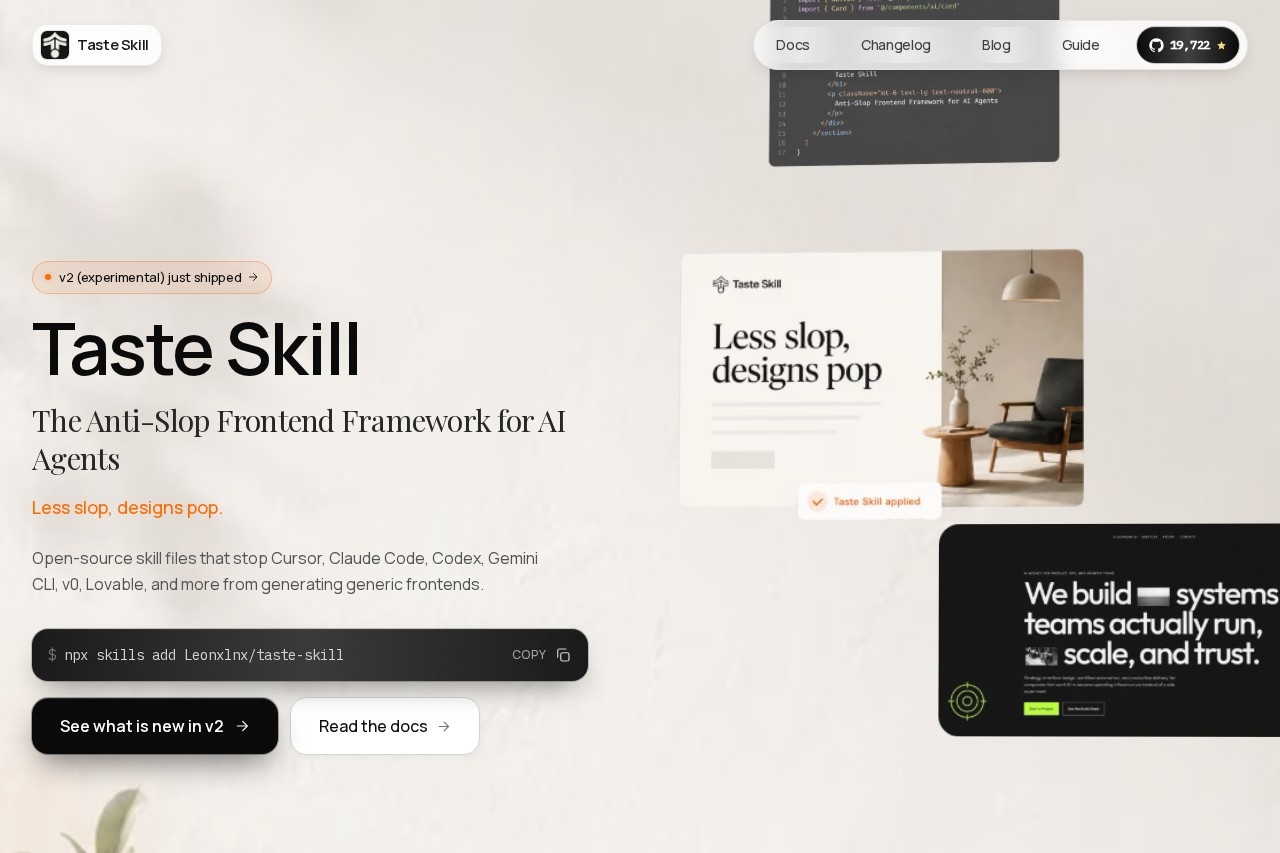
Taste Skill is a frontend framework that prevents AI-generated slop. It integrates with Cursor, Claude Code, and Codex to produce high-quality UI.
Introduction
As AI-assisted coding becomes increasingly common, frontend development faces a new challenge: AI tools generate large amounts of mediocre, stylistically inconsistent code. Taste Skill is an open-source framework built to solve this exact problem—widely regarded as the ultimate anti-slop frontend solution. By injecting good taste into mainstream AI coding assistants like Cursor, Claude Code, and Codex, Taste Skill ensures that every AI-generated interface follows unified design standards and code conventions. A single command completes the installation, elevating AI from merely "writing code" to "writing good code."
Key Features
- Taste Injection Engine: Compiles carefully crafted frontend style guidelines into AI-recognizable skill files, covering core dimensions such as layout, color, spacing, and typography.
- One-Click Installation: Integrates Taste Skill into Cursor, Claude Code, or Codex workflows with a simple CLI command.
- Real-Time Style Validation: Automatically detects and corrects non-compliant styles and structures while AI generates code.
- Open-Source Skill Library: Community-contributed taste presets (minimalist, modern, enterprise-grade, and more) that can be freely switched or combined.
- Zero-Intrusion Integration: Works directly on AI generation logic without requiring modifications to existing project configurations.
Highlights
- Ends "AI Slop": Prevents AI from generating cookie-cutter Bootstrap layouts or chaotic CSS, giving every project a unique and consistent visual language.
- Doubles Development Efficiency: Reduces time spent reviewing and fixing AI-generated code—straight from generation to delivery.
- Unified Team Collaboration: No matter who on the team is using AI-assisted coding, the output style remains consistent, lowering maintenance costs.
- Lightweight Design: The core library is only a few dozen KB, does not slow down AI response times, and takes effect immediately after installation.
- Continuous Evolution: The open-source community regularly updates taste presets to keep pace with design trends.
Who It's For
Frontend developers who want AI-generated code to match personal or team style standards and reduce rework; heavy AI tool users who rely on Cursor, Claude Code, or Codex daily and have high expectations for output quality; design system maintainers who need AI-generated UI components to align perfectly with existing design systems; technical managers looking to improve code quality and consistency in AI-assisted development across their teams; and independent developers who want to quickly build projects with professional visual polish while keeping code clean and standardized.