
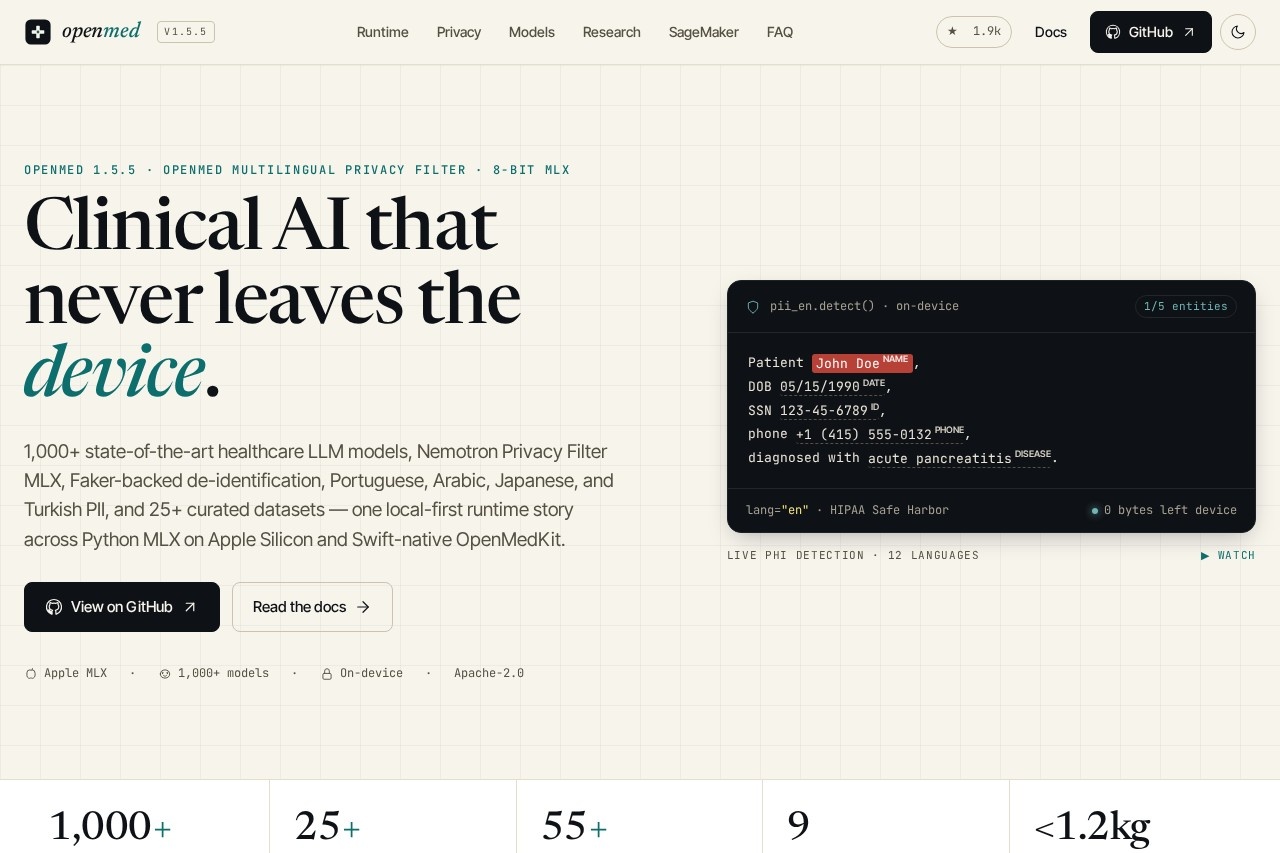
OpenMed 1.5.5 runs clinical AI on-device for privacy. Supports PII MLX, PyTorch/MLX, Faker, 1000+ LLMs, Swift, and OpenMedKit. Apache-2.0.
About
OpenMed is an open-source platform dedicated to bringing true offline intelligence to the healthcare sector. The latest version, 1.5.5, further strengthens privacy protection and multilingual support, ensuring that all clinical AI inference runs entirely on-device and that data never leaves the user’s terminal. Built on the Apache-2.0 license with a fully open stack, OpenMed covers the complete pipeline from model training to local deployment, offering healthcare institutions, researchers, and developers a secure, transparent, and customizable medical AI solution.
Key Features
Pricing & Fees
- Pricing: Not publicly listed on the pages we reviewed; check the official site for current plans. The site states the core package is "free forever" under an Apache-2.0 license with nothing to sign.
- Free tier / open source: Fully open source under Apache-2.0, including 2,200+ open models; installation requires no API key, account, or data-processing agreement.
- Plan limits: No subscription tiers are described; the same local installation runs on laptop CPU, Apple Silicon, or GPU server, with 0 bytes leaving the device.
- Platform availability: Installable via pip/PyPI (18.3M installs), with REST and gRPC service support and MLX acceleration on Apple Silicon.
- Billing quirks: The project contrasts itself with per-server subscription licensing for clinical NLP; no paid plans are mentioned on the site.
Who It's For
OpenMed is designed for healthcare institutions and IT teams looking to build localized, compliant clinical decision-support systems while minimizing data-exfiltration risks. It also serves medical AI researchers who want to fine-tune models on real de-identified data or run comparative experiments using the 1,000+ open-source LLMs. Mobile health app developers can use OpenMedKit to quickly integrate offline medical record analysis and symptom checking into iOS apps, and privacy compliance officers will find it a valuable, auditable, and verifiable anonymization solution for protecting patient data.
Related Tutorials
View all →
Related Tools
View all → OmniRoute - Free AI Gateway for Multi-Provider LLMs Free, open-source AI router with auto-fallback. 236 providers, one endpoint, 95 MCP tools, 17 routing strategies, A2A protocol, auto-combo engine, semantic cache, memory & skills. Deploy anywhere.
 Dograh - Voice Assistant Workflow Builder Open Source Voice Assistant Workflow Builder.
 LangChain LangChain provides a comprehensive suite of products to support developers throughout their entire development workflow.
 OpenHands Open-source, model-agnostic platform for building and deploying cloud coding agents. Automate real engineering work securely with full transparency and control.
 Agent-Native Apps Framework Build agentic apps where AI agents and UI share the same database and state. Open source framework with ready-to-fork templates.