
Continuous agentic pentesting and AppSec for the enterprise. Autonomous exploits validated against your live app, inside your perimeter. Built by the Shannon team.
About
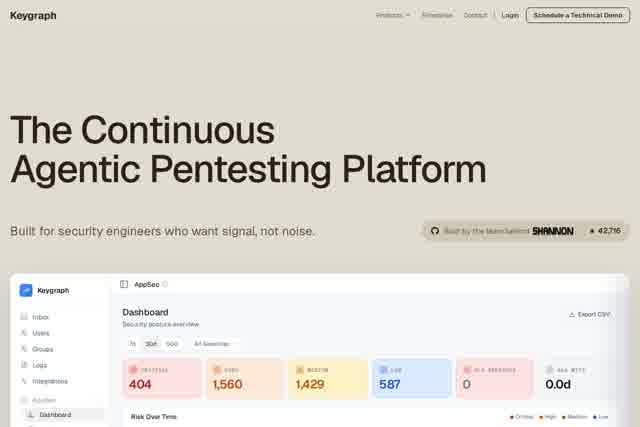
Keygraph is a next-generation enterprise-grade continuous security testing platform built by the Shannon team. It leverages autonomous agentic technology to perform automated penetration testing and vulnerability validation against real applications within your internal network environment. Unlike traditional security scanning tools, Keygraph simulates the behavior patterns of advanced attackers, automatically executing exploit attempts within controlled boundaries and delivering real-time security risk feedback. This product is designed for enterprises that require continuous, deep security validation, helping security teams discover and remediate critical vulnerabilities before an attack occurs.
Key Features
Pricing & Fees
- Pricing: Keygraph offers four plans: Shannon OSS ($0, self-run), Community Program ($0 for eligible nonprofits and pre-Series-A startups), Pro ($50 per developer/month, cloud-hosted), and Enterprise (custom pricing, self-hosted).
- Free tier: Shannon OSS is free forever and can be run locally or in CI with no seat or usage caps; you only pay your own model costs.
- Free community access: Keygraph Pro is available at no cost to U.S. 501(c)(3) nonprofits and pre-Series-A startups, with up to 20 active developers, month to month while they qualify.
- Plan limits: Pro includes every module with unlimited repositories and scans, SSO, RBAC, audit logs, and Jira sync; Enterprise adds self-hosted or air-gapped deployment, a dedicated engineer, and custom SLAs.
- Deployment options: Pro is hosted and managed by Keygraph, while Enterprise supports self-hosted and fully air-gapped environments with a custom DPA.
Who It's For
Keygraph is built for enterprise security operations teams (SOC) who need continuous monitoring and validation of application security posture to reduce attack surface; DevSecOps engineers looking to embed automated security validation into development and release pipelines for higher delivery quality; penetration testers and red teams seeking efficient, repeatable automation to augment manual testing with greater depth and frequency; and security leaders and CISOs who need quantifiable, trustworthy security data to support risk decisions and compliance audits.
Related Tutorials
View all →
Related Tools
View all → PentAGI - Advanced AI-Powered Penetration Testing Fully autonomous AI Agent for complicated penetration testing tasks.
 Yuxi - RAG Harness for AI Agents Yuxi provides a RAG harness to enhance AI agents with retrieval-augmented generation capabilities.
 omp - A Coding Agent with the IDE Wired In Oh My Pi (omp) is a coding agent that integrates with your IDE, leveraging LSP and DAP for seamless development. Built in Rust for performance.
 DeepEval by Confident AI - LLM Evaluation Framework Open-source LLM evaluation framework with 50+ plug-and-play metrics for AI agents, RAG, chatbots, and more.
 OmniRoute - Free AI Gateway for Multi-Provider LLMs Free, open-source AI router with auto-fallback. 236 providers, one endpoint, 95 MCP tools, 17 routing strategies, A2A protocol, auto-combo engine, semantic cache, memory & skills. Deploy anywhere.